Cause of Injury
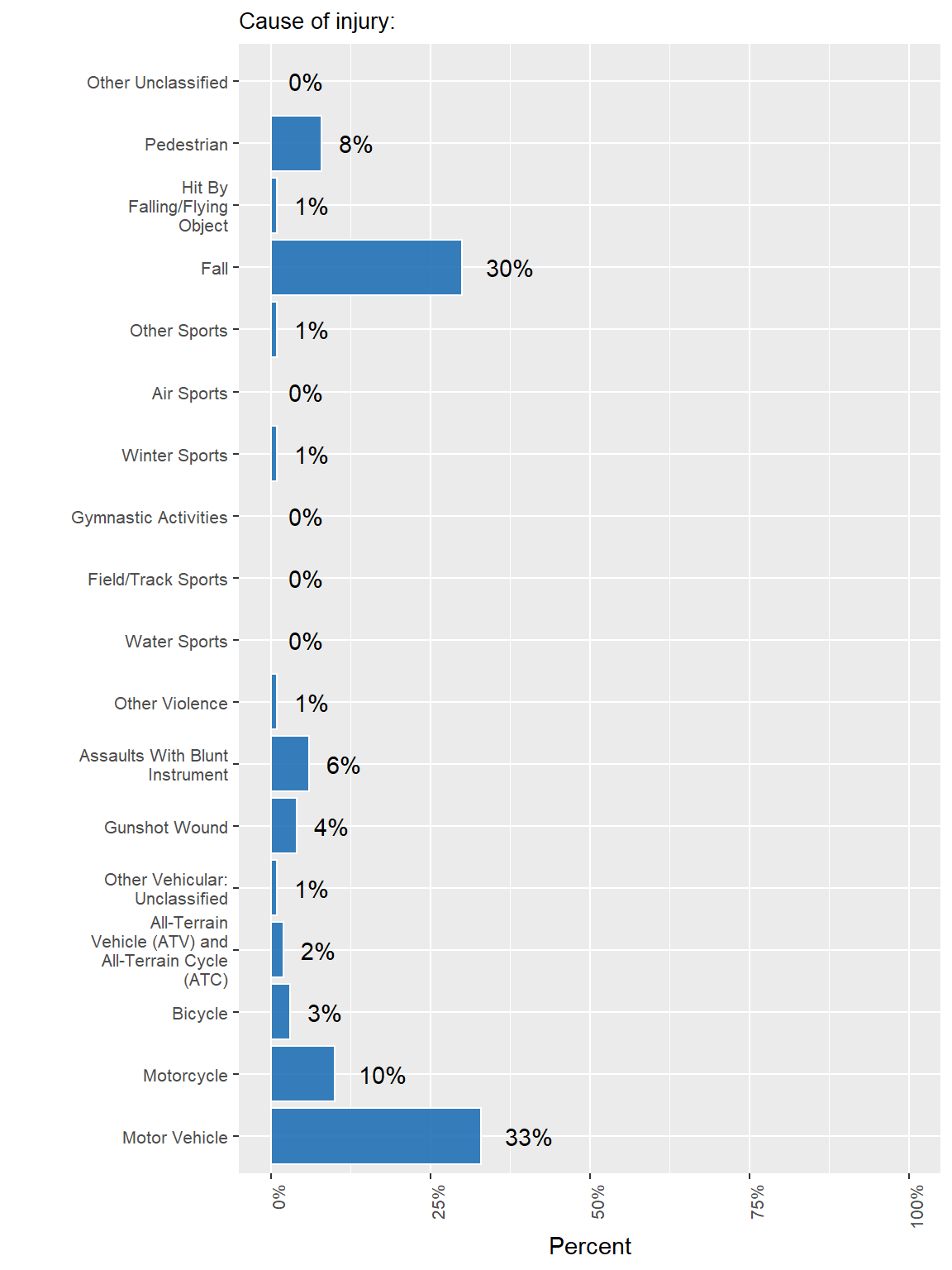
Cause of Injury is an important variable. Data collector should always know cause of TBI (needed to determine study inclusion), therefore cause and ICD External Cause of Injury codes should never be missing or unknown.
Cause of injury should correspond with the primary ICD External Cause of Injury Code and both codes should correspond with the narrative documented in the medical chart (history and physical) pay special attention to description of injured person (ie passenger, driver, pedal cyclist, etc.)
If the cause is not known, investigate as thoroughly as feasible and make a determination if possible. Also, be alert to information becoming available at a later time and be ready to record and submit it.
If person is found “down”, try to determine what happened.
On rare occasions, the cause of injury (Cause of Injury and ICD External Code variables) may be coded as “unknown” if unable to determine the mechanism or circumstances of injury. However, the data collector/admitting physiatrist should still be able to conclude that the primary mode of injury was traumatic in these cases, as this is a requirement for inclusion in the study.
ICD External Cause of Injury Codes
When taking External Cause of Injury Codes from the Medical Record, they should be checked to ensure that they reflect the best / most current information available about the cause of the injury. Data collectors may submit ICD External Cause of Injury Code that differ from those recorded in the Medical Record in cases where they feel the Medical Record ICD External Cause of Injury Code may not reflect the best / most current information available. There should be clear documentation on the data collection form when an ICD External Cause of Injury Code entered into the database does not reflect the ICD External Cause of Injury Code recorded in the Medical Record. In unusual cases where no ICD External Cause of Injury Code relative to the injury that resulted in traumatic brain injury is recorded in the Medical Record, the data collector should use best judgement and the consultation of other personnel, as necessary, to determine the appropriate ICD External Cause of Injury Code from the TBIMS database list.
Code 2 causes of injury if there were 2 causes. If only one cause, the second ICD External Cause of Injury Code should be coded as the place of injury.
Place of injury codes should be used with any primary ICD External Cause of Injury Code to denote the PLACE where the accident or poisoning occurred. This code should always be secondary, never primary.
Late effects of injury codes are to be used to indicate circumstances classifiable as the cause of death or disability from late effects related to an injury. These include conditions reported as such, or occurring as sequelae one year or more after injury purposely inflicted by another person or injuries where intention is undetermined.
The TBIMS inclusion criteria specifies that participants present to the Model System ED with injuries occurring within 72 hours of admission. Therefore, all cases with a late effect external code listed as primary should be reviewed to assure that the injury is truly new and not pre-existing. If the current admission is due to a pre-existing TBI, this case does not fit the TBIMS inclusion criteria and should be excluded from the study.
ICD External Cause of Injury Codes can be assigned by data collector if medical record personnel unavailable.
888 (fall) is a valid External Cause of Injury ICD Code. Don’t use 888 as “not applicable” (88888 = not applicable).
88888 should NEVER be the primary External Cause of Injury ICD Code, but can be the secondary code.
Include the preceding “V”, “W”, “X”, or “Y” for ICD-10 cause of injury codes.
The following ICD External Cause of Injury Code should rarely, if ever, be the primary. These codes should be reviewed and validated prior to data entry: - accidental poisoning by drugs, medicinal substances; - accidental poisoning by other solid and liquid substances, gases, and vapors; - misadventures to patients during surgical and medical care; surgical and medical procedures as the cause of abnormal reaction of patient or later complication, without mention of misadventure at the time of the procedure; - accidents caused by fire and flames; - accidents due to natural and environmental factors; - accidents caused by submersion, suffocation, and foreign bodies; - assault by corrosive or caustic substance (except poisoning) - assault by poisoning - assault by hanging and strangulation - assault by submersion - drowning - assault by hot liquid - injuries undetermined whether accidentally or purposely inflicted
If two vehicles are involved, the cause of injury should be coded according to the vehicle on/in which the patient was riding (e.g. patient cycling on a bicycle and hit by a car, the cause would be the bicycle since that is the vehicle the patient was riding on.)
If two events are involved, the cause of injury should be coded according to the initial event (e.g. patient riding a bicycle fell, lost control and fell into ditch would be coded as a bicycle accident, not a fall.)
If two events are involved, and the participant sustains injuries from both events, the cause of injury should be coded according to the initial event. (e.g. patient hit in the head and fell to ground hitting head again would be coded as assault). If in doubt which event occurred first, ask the TBIMS physician which cause would be primary based on the extent of injury apparently caused by both events.
If person jumps from a moving vehicle, use code 19 in this variable, however, use appropriate vehicular ICD external code (E818.? for ICD-9 or V87.8XXA for ICD-10) ICD External Cause of Injury Code [CSEICD].
If injury occurred in parking lot of a public building, code “Y92.481 - Parking lot as the place of occurrence of the external cause”.
Cause of injury for patients who were “struck by a fist” should be coded as ‘’11 = Assaults with blunt instrument (non-penetrating)’‘. Although an’‘instrument’’ was not technically utilized in the assault, this code best describes the etiology of the injury.
Do not include codes regarding drug or alcohol use or intoxication at the time of the injury in the External ICD code fields.